
Romeoville City Directory Sources
No official standalone Romeoville residential directory was found during the source review. That gap should shape the search, not end it. Romeoville residents appear through collections held by the White Oak Public Library District, Joliet Public Library, the Romeoville Area Historical Society, and the Illinois Regional Archives Depository system. Each collection answers a different kind of question.
| Collection | Years | Where Held | Access |
|---|---|---|---|
| Romeoville-area newspapers | 1975-2009, with gaps and title changes | White Oak Romeoville Branch | Library-only microfilm |
| Will County directories | 1859-60 and 1872-73 | Joliet Public Library | Local-history collection |
| Joliet city directories | 1875-present | Joliet Public Library | Library collection; one 1968 item online |
| Family, school, and business files | Varied | Romeoville Area Historical Society | Contact or museum appointment |
| Will County public records | 1830s onward, series-dependent | IRAD at Northern Illinois University | Finding aid and repository request |
Coverage is not proof that a given name appears. Ask the keeper to confirm the exact title, date span, format, and access terms before planning a visit. A county directory can supply regional context while still omitting a Romeoville household.
Romeoville Newspaper Directory Trail
The White Oak Romeoville Branch local-history inventory is the strongest town-specific date guide. Its newspaper microfilm includes the Beason Sun, Romeoville Sun, The Sun, and Reporter across a documented 1975 through 2009 window, with gaps and title changes. Newspapers can supply obituaries, school honors, club lists, business notices, legal notices, and address clues that no alphabetical city directory preserves.
The Local History Reference Collection is library-only. The branch is at 201 W Normantown Road and lists Monday through Thursday hours of 9 a.m. to 9 p.m., Friday and Saturday 9 a.m. to 5 p.m., with Sunday closed. Confirm hours before travel. Bring a narrow date range, every known spelling, and the type of event sought. Search Romeoville and older place labels without silently changing the wording in a citation.
The manifest image below records the library's published newspaper inventory. Review the White Oak source page before using the dates.
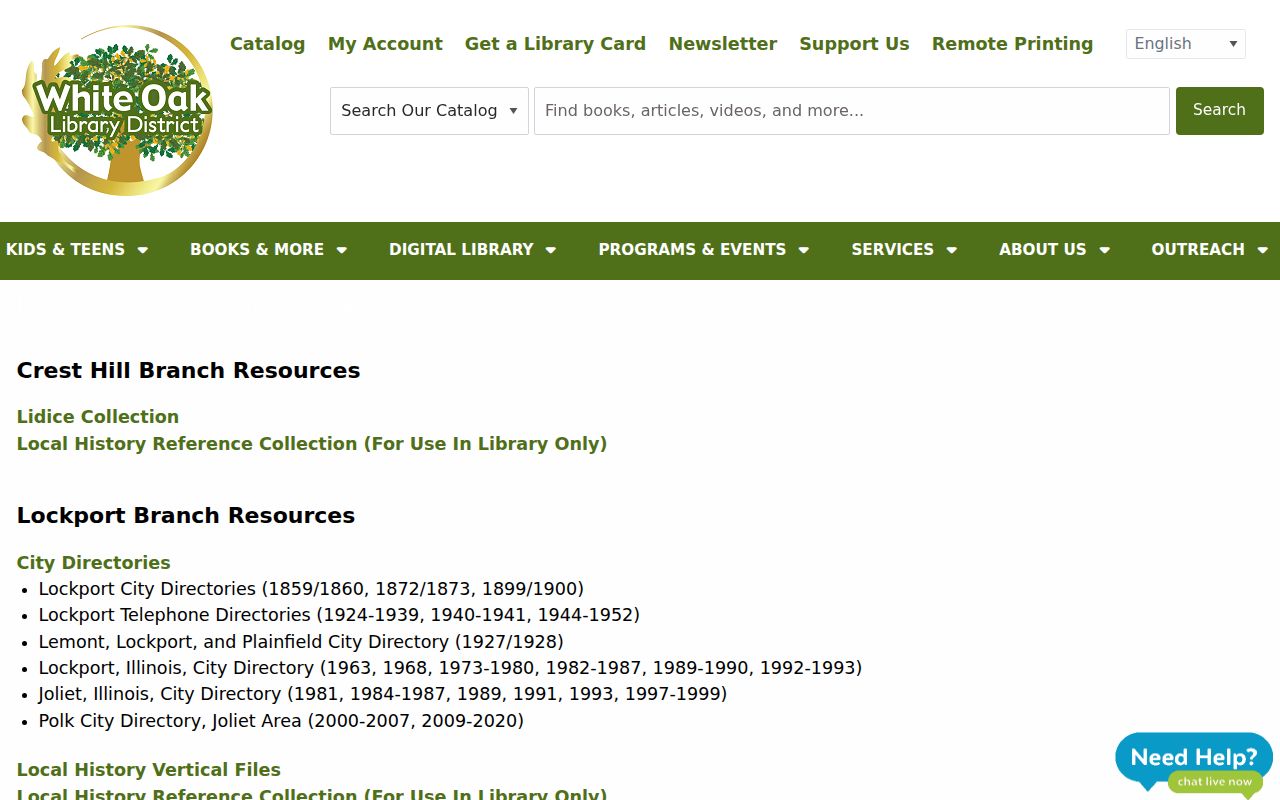
A blank search may reflect a missing issue, a title change, or an event outside the known month. It does not prove the person was absent from Romeoville.
Will County Directory Books Nearby
Joliet Public Library's history and genealogy collection extends the search beyond the village. It identifies Will County directories for 1859-60 and 1872-73, Joliet city directories from 1875 forward, newspapers from 1846 forward, atlases and plat books, yearbooks, and obituary indexes. A local-history librarian appointment is available. Staff newspaper searches require a month and year, so a broad surname alone is not enough.
The library also links a digitized 1968 Joliet directory. The inspected PDF showed an eight-page business and classified segment, with listing name, address or phone, classification, and advertisement text. It did not expose a residential Romeoville page. Use it to learn the publication's abbreviations and layout, not to claim a complete Romeoville household roster.
See the Joliet genealogy resources shown below.

Read Romeoville Directory Clues
A city directory entry is a dated clue. It may show a listed name, street address, telephone number, work or business classification, spouse, or an abbreviation supplied by the publisher. Those fields differ by volume. Never add a spouse, occupation, or owner status unless the page actually states it.
- Name: copy initials, suffixes, and spelling exactly.
- Address: retain the street form and place label printed that year.
- Work or class: treat it as the publisher's category for that edition.
- Phone: record the number as a historical identifier, not a current contact.
- Marks and abbreviations: decode them from that volume's key.
- Criss-cross directory
- A book arranged by street or telephone number rather than surname.
- Householder index
- An address-keyed list naming the person the publisher treated as head of the listed household.
- Abbreviation key
- The publisher's legend for shortened jobs, street types, marital notes, and other marks.
Compare the entry with a census, obituary, deed, or later issue. A printed address shows an association at publication time. It does not establish current occupancy or legal ownership.
Romeoville Family Files and Maps
The Romeoville Area Historical Society museum holds family, business, school, and local-organization material. Its collection description includes early farming families, obituaries, printed articles, school resources, and a street map naming the first Hampton Park homeowners. That map is a rare person-to-address bridge for local family history.
Contact the Society instead of recreating its map from current parcel data. Ask whether a surname, block, school year, business, or organization appears, then request the collection title and date. The Society uses a contact form and lists 815-552-9080; regular hours were not found, and appointment or seasonal limits may apply.
The museum holdings page is captured below.
Human-use clue. The Hampton Park homeowner map can reconnect a family with an early address, but its date and collection context must travel with every name.
Romeoville Records Across Time
Place history tells a researcher where to look. The first Romeo plat was recorded in Cook County in 1835, before Will County existed. Romeoville incorporated in 1895 after a 42-20 vote at John Miller's barbershop. Later growth and the Hampton Park annexation changed the scale of local records. White Oak's newspaper run then supplies a much more recent window.
| Year | Record clue |
|---|---|
| 1835 | Romeo plat recorded in Cook County before Will County's creation. |
| 1895 | Incorporation and name-change vote entered the municipal record. |
| 1903 | Santa Fe depot fire became a distinct newspaper phrase search. |
| 1957-1964 | Hampton Park development and annexation reshaped household geography. |
| 1975-2009 | Documented Romeoville newspaper film runs, with gaps. |
The Fire Department history says residents and a former mayor moved 500 pounds of dynamite away during the 1903 depot fire. Search “Santa Fe depot,” “dynamite,” “Romeo,” and “Romeoville” in period papers. Preserve the wording the paper used.
Romeoville Research Through IRAD
The IRAD local-government records search accepts a county, title text, and depository. Will County findings include birth records, circuit court series, assessor books, cemetery records, and board minutes. Some begin in the 1830s. A catalog hit is a finding aid, not a scanned record.
Write down the exact series title, date span, and repository. Then contact the Northern Illinois University depository about the box, volume, film, access rule, and copy method. This route is vital when a Romeoville city directory search reaches an era before the known local newspaper runs or when early custody falls outside a modern village office.
Note: County and municipal boundaries changed, so the record keeper for an early Romeoville clue may differ from today's custodian.
Trace Romeoville Families by Year
A sound family trail moves one dated source at a time. It never assumes that a name absent from the next book means death or departure. Publication gaps, unlisted households, spelling changes, and shifting place labels all create false breaks.
- Start with the best dated name or address and note its source.
- Check the nearest city directory, yearbook, or newspaper issue in both directions.
- Record each address change and all printed name variants.
- Pair directory years with federal census years and county records.
- Use obituary indexes, cemetery material, or family files to explain a final appearance.
For newer address-keyed work, use the Romeoville street directory rather than treating an old city directory entry as current. Save a citation for every volume or issue, including title, date, page, repository, and the date viewed. That small habit keeps two similar names from merging into one life.